On May 30, a group of university students will walk into a purpose-built pickleball venue in Stourbridge and play for something that did not exist a year ago.
Not a title in the traditional sense. Not a ranking that feeds into a global tour.
Key Takeaways
- The first British Collegiate Pickleball National Championship on May 30 represents a milestone for youth development in the UK
- Schools and universities are becoming the critical pipeline for growing pickleball’s next generation of players and fans
- The challenge is creating structured pathways from first exposure to competitive play, not just one-off introductions
This article features in the May 2026 issue of World Pickleball Magazine. For the full collection of features, interviews, coaching insights and global coverage, download the complete magazine here.
Something earlier than that.
A pathway.
The inaugural UK University Pickleball Championships will bring together teams from across the country, many of them playing their first structured competition. The level will vary. The experience will be uneven. Some players will arrive as unknowns.
That is the point.
Because for all the conversation around professional tours, investment, and global expansion, the future of pickleball in England is being decided somewhere else entirely.
In schools, universities, and junior leagues where the sport is still being introduced, shaped, and understood. Organisations like Pickleball England are playing a key role in connecting schools with the resources they need to introduce the sport.
Where Growth Actually Comes From
Pickleball’s rise is often explained through accessibility. It is easy to learn, relatively inexpensive, and adaptable to different spaces.
That makes it easy to start.
It does not guarantee that it lasts.
Long-term growth depends on something more deliberate. It requires players to move from first experience to regular participation, and from participation into something that feels structured and worth returning to.
That is where schools and education begin to matter.
Not as an add-on, but as a system.
Pickleball England’s long-term ambition reflects that. The target is to reach 10,000 schools and inspire more than 400,000 junior participants by 2030, alongside the creation of a connected inter-school and club competition pathway.
Those numbers are significant, but the mechanism behind them is more important.
It is not about exposure. It is about continuity.
Making It Work Inside Schools
Introducing a sport into schools is rarely as simple as enthusiasm.
Teachers need to feel confident delivering it. Sessions need to fit into existing structures. Equipment has to be available, affordable, and practical.
Without those pieces, even well-intentioned programmes struggle to last.
That is why much of the current work is focused on making delivery easier rather than more ambitious.
Teacher training is being developed through Continuing Professional Development programmes. Curriculum frameworks are being aligned to Key Stages so that pickleball can slot into existing PE structures. Equipment packs are being designed to remove cost as a barrier.
None of this is visible from the outside.
But it is the difference between a sport being tried once and a sport being embedded.
If you’re following how the global game is shifting week by week, the World Pickleball Report breaks this down every Wednesday.
From First Hit to First Competition
The next step is connection.
A school session on its own is not enough. Players need somewhere to go next.
That is where the emerging competition structure begins to take shape.
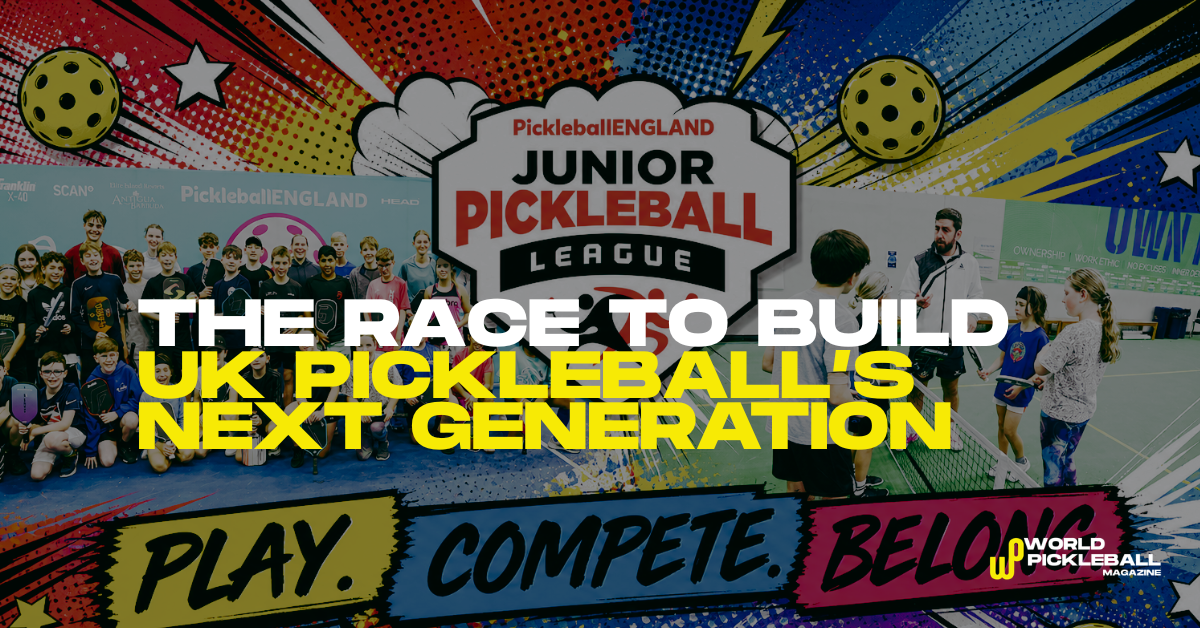
On May 31, the day after the university championships, the Junior Pickleball League – South will launch in Eastleigh. Built around a doubles league format, it is designed to introduce younger players to competition in a way that emphasises communication, resilience, and confidence rather than immediate results.
These events are early, and they are small.
But they represent something more important than scale.
They create a link between introduction and progression.
From school sessions to after-school play. From after-school play to local competition. From local competition to something that begins to resemble a pathway.
What Comes Next
The structure is still forming.
There are gaps. Access is uneven. The system is not yet complete.
But the direction is becoming clearer.
Pickleball in England is not just expanding outward. It is beginning to build inward, creating the kind of framework that allows participation to turn into habit, and habit into long-term involvement.
That matters, because the future of the sport will not be decided by how many people try it once.
It will be decided by how many keep playing.
And that decision is not made on a professional court.
It is made much earlier than that.
For a clearer view of where the sport is heading each week, you can join the World Pickleball Report here.
Further Reading
- Latest pickleball news from around the world
- Tournament coverage and results
- Rankings and player profiles
- Regional pickleball coverage

Chris Beaumont
Founder and Editor-in-ChiefChris Beaumont is the founder and Editor-in-Chief of World Pickleball Magazine. Chris follows the global game closely, reporting on the latest news, developments, stories and tournaments from all five continents. He also hosts the World Pickleball Podcast, interviewing people at…
View All Articles →