by Chris Beaumont and Karen Mitchell
The State of Play 2026 report from Sporting Goods Intelligence highlights a shift that is now impossible to ignore across racquet sports: the boundaries between tennis, padel and pickleball are blurring. Facilities are shared, players are crossing over, and investment is flowing across all three.
Key Takeaways
- Pickleball’s governance remains fragmented, with tennis governing bodies retaining control in many countries
- The lack of a single, independent international federation such as the Global Pickleball Federation is hindering the sport’s path to Olympic recognition
- The State of Play 2026 report highlights that independent national governance is now essential for pickleball’s legitimacy
This article features in the May 2026 issue of World Pickleball Magazine. For the full collection of features, interviews, coaching insights and global coverage, download the complete magazine here.
But within that convergence lies a defining question for pickleball’s future: who actually governs the sport?
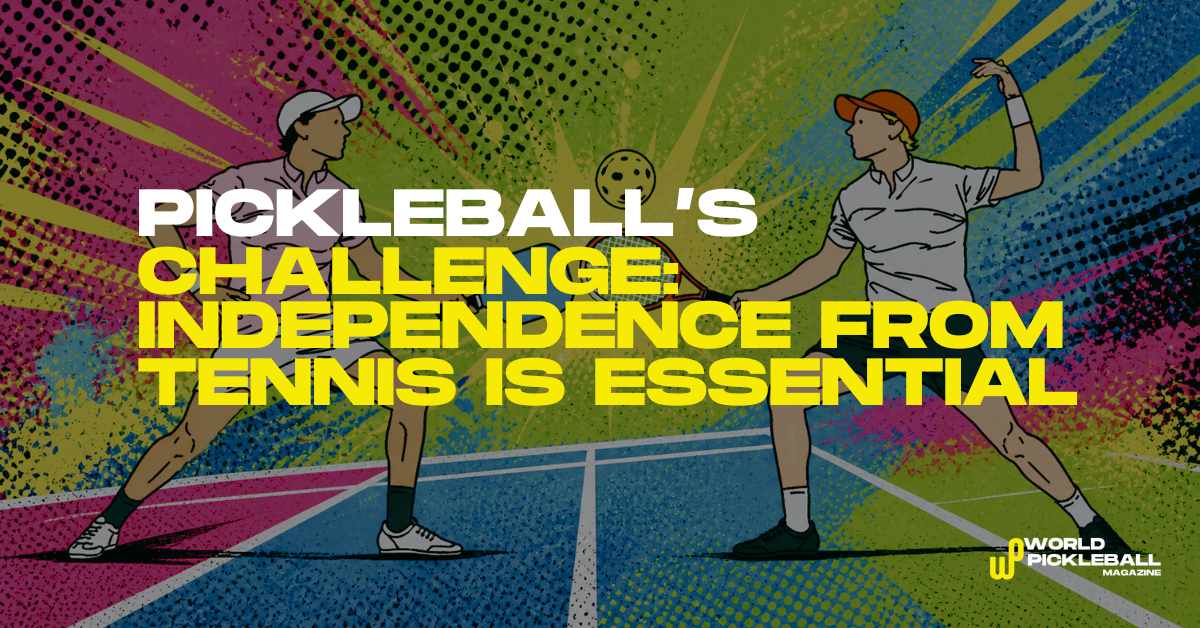
The Hidden Conflict: Tennis Governing Pickleball
In many countries, national tennis federations have taken on responsibility for emerging racquet sports, including pickleball and padel. On the surface, this is logical:
- They have infrastructure
- They understand racquet sports
- They are already connected to funding and government systems
However, this creates a structural conflict of interest.
Tennis is no longer just a partner sport. It is a direct competitor for players, facilities, and investment. The same report points to increasing player crossover and the rise of multi-sport facilities, where decisions are made based on revenue, utilisation, and growth potential.
In that context, expecting tennis-led organisations to objectively prioritise pickleball’s long-term development is becoming unrealistic.
Why One International Federation Matters
This is where the need for a single, recognised International Federation (IF) for pickleball becomes critical—not just for coordination, but for structural independence.
The WPF has been clear on this point: structural independence from tennis is necessary, and it remains a central objective.
A credible IF would not replace national bodies, but it would set the framework within which they operate.
1. Enabling Independent National Governance
A recognised IF can establish minimum governance standards that all national bodies must meet.
Crucially, this includes the ability to require:
- Dedicated pickleball leadership structures
- Clear separation from competing sport priorities
- Accountability to the global pickleball community
This does not exclude tennis federations from playing a role—but it ensures that pickleball is not structurally subordinate to them.
2. Protecting the Integrity of the Game
Recent developments at the professional level underline another growing risk. The United Pickleball Association has introduced its own rulebook for its pro tour and Major League Pickleball.
Innovation is valuable. Fragmentation is not.
Without a single governing authority:
- Multiple rulebooks can emerge
- The sport risks divergence between professional and recreational play
- Global consistency is weakened
A unified IF must act as the final authority on the laws of the game, ensuring that innovation happens within a coherent global framework.
If you’re following how the global game is shifting week by week, the World Pickleball Report breaks this down every Wednesday.
3. Supporting the Path to Global Recognition
For pickleball to achieve full international recognition—including potential Olympic inclusion—it must demonstrate:
- Unified governance
- Global rule alignment
- Credible institutional structures
These are not optional. They are prerequisites. Without them, the sport’s global ambitions become harder to realise.
4. Nurturing One of Pickleball’s Greatest Strengths
One of the most compelling insights from the report is pickleball’s unique participation profile.
In England, for example, women outnumber men in the sport, making it the only major racquet sport where this is the case.
This is more than a data point. It is a defining strength of the sport.
But it is not guaranteed to persist. It requires:
- Inclusive competition structures
- Equal visibility and opportunity
- A continued focus on accessibility and social play
A fragmented governance landscape risks losing this advantage. A unified IF can ensure it is protected and developed intentionally.
5. A Global Sport Without Global Data
There is another, often overlooked, challenge facing pickleball’s development: we do not yet have a reliable global picture of the sport.
The State of Play 2026 report is telling in this regard. Tennis and padel are presented with clear global participation figures—106 million and 35 million players respectively—yet pickleball is largely represented through US data alone.
This is not because pickleball is small. Quite the opposite is true.
The sport is now played in 75+ countries, with rapid growth across Asia, Europe and beyond. But many of these nations are at very different stages of development:
- Some have established national bodies and club systems
- Others are driven by informal, community-led play
- Many lack the infrastructure to systematically track participation
The result is a fragmented and unreliable data landscape:
- No consistent definition of “player”
- Limited visibility on clubs, courts, or participation frequency
- No global benchmarking across regions
By contrast, tennis and padel benefit from centralised reporting structures, coordinated through their international federations.
This is not just a statistical issue—it is a strategic one.
Without reliable global data:
- It is harder to secure government recognition and funding
- Commercial partners lack confidence in the scale of the opportunity
- International comparisons are weakened
- Long-term planning becomes reactive rather than evidence-based
A single International Federation would play a critical role here—not just in governance, but in measurement.
It could:
- Define global standards for participation data
- Coordinate reporting across national bodies
- Build a credible, unified picture of the sport’s growth
Because ultimately, what gets measured gets supported.
Conclusion: A Moment That Requires Clarity
Pickleball has grown rapidly by being accessible, social, and adaptable. But as the sport matures, those same qualities need to be supported by clear structures.
The question is no longer whether pickleball will organise itself globally, but how quickly it can do so with clarity.
National bodies are already making alignment decisions in the absence of a single recognised International Federation—often based on governance principles such as democratic representation, structural independence, and the need for credible global data.
If pickleball is to fulfil its global potential, those principles must converge into a single, shared framework for the sport.
For a clearer view of where the sport is heading each week, you can join the World Pickleball Report here.
Further Reading
- Latest pickleball news from around the world
- Tournament coverage and results
- Rankings and player profiles
- Regional pickleball coverage

Chris Beaumont
Founder and Editor-in-ChiefChris Beaumont is the founder and Editor-in-Chief of World Pickleball Magazine. Chris follows the global game closely, reporting on the latest news, developments, stories and tournaments from all five continents. He also hosts the World Pickleball Podcast, interviewing people at…
View All Articles →