
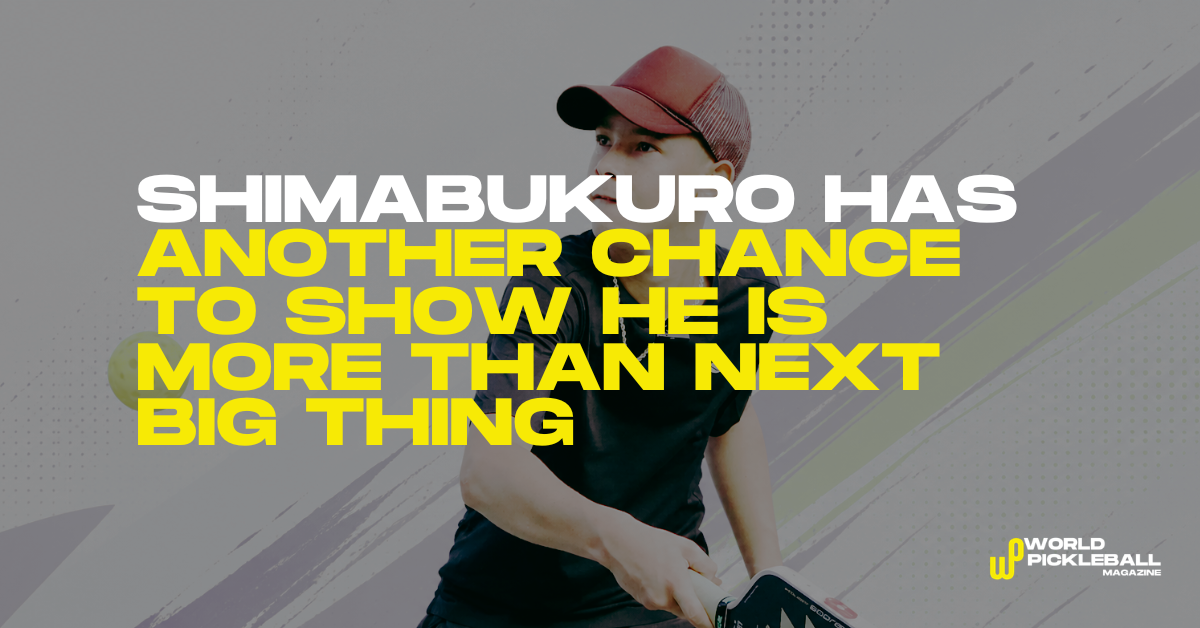
The 15-year-old arrives at the Macao Open after a breakout month that has taken him from exciting prospect to serious contender. Now comes the harder part: proving this level can last.
- Tama Shimabukuro heads into the Macao Open after winning mixed doubles gold at the Panas Kuala Lumpur Open.
- The 15-year-old has already shown he can trouble established elite players on major stages.
- His next challenge is turning attention, athleticism and crowd support into sustained results.
The crowd had to wait before the score could be called.
Not because of a dispute.
Not because of an injury.
Because they were chanting Tama Shimabukuro‘s name so loudly that play could not properly continue.
For a 15-year-old still in the early stages of his professional career, it was a striking moment. It also captured something important about Shimabukuro’s rapid rise.
He is no longer just a talented teenager worth keeping an eye on.
He is becoming one of the most compelling young players in the sport.
A Breakout Month
Shimabukuro arrives at this weekend’s Macao Open fresh from mixed doubles gold in Malaysia, where he partnered Alix Truong to victory at the Panas Kuala Lumpur Open.
That result alone would make him one of the players to watch in Macao.
But it sits within a much bigger month.
Born and raised in Hawaii, Shimabukuro only began playing pickleball in 2023, aged 12. He turned professional in 2025 and has since built a reputation as one of the sport’s most exciting young players.
His rise has been fast, but not empty.
Shimabukuro already owns a 6.094 DUPR in doubles and 6.295 in singles, where he is ranked among the leading men’s players in the world.
The numbers help explain the attention.
The performances explain the excitement.
If you’re following how the global game is shifting week by week, the World Pickleball Report breaks this down every day in our morning briefing.
The Athletic Edge
Shimabukuro’s greatest strength is his athleticism.
He is quick, agile and relentless in defence, capable of keeping points alive long after they appear lost.
What makes that even more interesting is that he is still physically developing. He has not reached his peak strength, nor fully grown into his adult body.
That creates an obvious question.
If he is already this difficult to beat now, what happens when the physical side of his game catches up with his experience?
Technically, there are still areas to refine.
His backhand volley has been one of the clearest points of development, particularly the balance between a one-handed shot and the two-handed backhand, often called a “twoey”.
The best players in the game, including Ben Johns, Christopher Haworth and Federico Staksrud, mix those options with precision. Shimabukuro has shown signs of improving that part of his game since the turn of the year.
That matters because his ceiling is not only about speed or energy.
It is about whether he can keep adding layers to a game already causing problems for elite opponents.
The Atlanta Moment
Shimabukuro’s breakthrough became impossible to ignore at the Veolia Atlanta Pickleball Championships.
Speaking to The Kitchen Pickleball, he described the experience of having the crowd behind him during his run.
“I’m still trying to really think about it, I didn’t think I’d make a final that soon,” Shimabukuro said.
“And then to have that crowd behind me for the entire tournament, it was just insane.
“In-between timeouts, I’m not sure what game it was, it was 0-0 in the third game, and they just started a Tama chant, and we had to wait 10 seconds before they could say the score.
“That was insane. It was so loud.”
That tournament felt like his first big arrival.
He reached Championship Sunday for the first time in his career and did so in two events, men’s singles and men’s doubles alongside Yuta Funemizu.
In singles, his route was demanding.
Starting as the 22nd seed, he beat 13th seed Jaume Martinez Vich in the first round before defeating second seed Federico Staksrud in the round of 16.
Noah Khlif, the 11th seed, was brushed aside in the quarter-finals before former world number one Hunter Johnson was beaten in the semi-finals.
Only Haworth, the number one seed, proved a step too far in the final.
More Than A Crowd Favourite
Shimabukuro’s run also showed the power of the crowd in pickleball.
Support can change the atmosphere of a match. It can lift a player, add pressure to an opponent and turn a good performance into something that feels bigger.
But it would be wrong to reduce his Atlanta success to crowd support alone.
The crowd did not carry him to the final.
His level did.
Shimabukuro’s relentless energy, improving technical base and willingness to stay in points make him a difficult opponent for even the best players in the world.
His style suits the underdog role. He can chase, extend and frustrate. But as his game matures, the question is whether he can move beyond being the young disruptor and become a regular title threat.
The Next Big Thing Problem
That is the challenge with young talent in any sport.
Potential is exciting.
Expectation is heavier.
We have seen young stars in other sports, most notably Emma Raducanu in tennis, show world-class flashes early before facing the far more difficult task of sustaining that level under pressure, attention and physical demand.
That comparison is not a warning sign against Shimabukuro.
It is a reminder that development is rarely linear.
The jump from promising teenager to consistent elite player is one of the hardest in sport.
So far, Shimabukuro appears to be handling the attention well. He speaks with humility, seems energised by support and continues to show a clear appetite for improvement.
That balance may be just as important as any technical adjustment.
Another Chance In Asia
Asia is where Shimabukuro won his most recent gold medal, partnering Truong to beat Xiao Yi Wang-Beckvall and Len Yang 11-3, 3-11, 11-2 in the mixed doubles final on May 17.
Now Macao offers another test.
He is set to play with Armaan Bhatia in men’s doubles, Jamie Haas in mixed doubles and also compete in the men’s singles round of 16.
It is another opportunity to show that his recent form is not a flash in the pan.
For the first time in his young career, Shimabukuro is arriving at a major tournament not simply as an outsider to watch, but as a player expected to contend.
The next step is proving those expectations are justified.
Further Reading
- Latest pickleball news from around the world
- Tournament coverage and results
- Rankings and player profiles
- Regional pickleball coverage
For a clearer view of where the sport is heading each month, you can download the latest free issue of World Pickleball Magazine.

Will Russell
EditorWill Russell is a journalism student at the University of Central Lancashire (UCLan) and a contributor to the World Pickleball Magazine Academy. He is particularly interested in player development, emerging talent and the stories shaping pickleball's growth around the world.
View All Articles →