The courts are full. The barriers to entry are practically nonexistent. Across the globe, millions of people are picking up paddles and experiencing the instant appeal of the world’s fastest-growing sport.
But there is a glaring disconnect at the heart of pickleball’s rise: the courts are packed, but the grandstands remain empty.
Key Takeaways
- Pickleball has millions of players but struggles to convert participants into spectators and fans
- The sport’s quirks, from kitchen rules to rally dynamics, could become its greatest spectator assets if marketed creatively
- Adjacent fandoms and crossover audiences offer pickleball’s best route to building a genuine fanbase
This article features in the May 2026 issue of World Pickleball Magazine. For the full collection of features, interviews, coaching insights and global coverage, download the complete magazine here.
You can put 30 avid, paddle-obsessed players in a room, have a generational talent like Ben Johns walk through the door, and there’s a good chance no one would even look up. Pickleball has solved the hardest problem in sports—getting people to actually play. What it hasn’t solved is how to turn those millions of players into a genuine fandom.
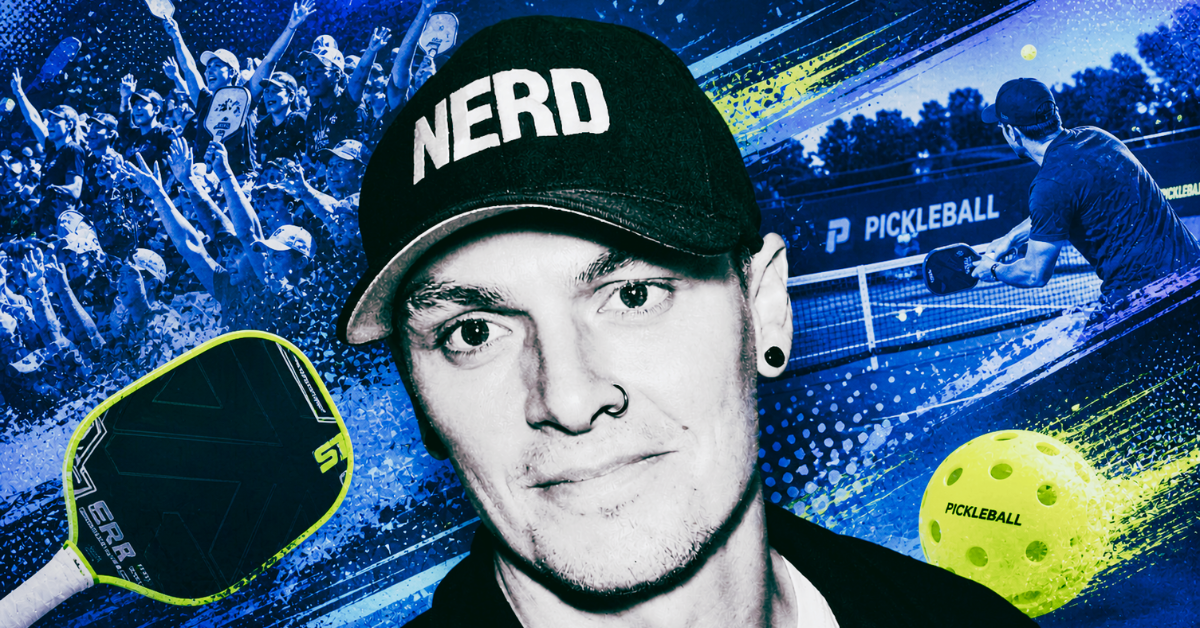
For Calvin Innes, an award-winning executive creative director, fandom strategist, and co-founder of the agency The Forge, the answer to this “Pickleball Paradox” lies in shifting the sport’s focus from mechanics to world-building.
“It’s solved the most difficult problem, which is access. There are very few barriers to entry,” Innes explains. “But what that doesn’t do is solve the attachment issue. It comes down to a really simple thing: it’s storytelling. It’s world-building.”
The ‘User’ vs. The ‘Fan’
To understand pickleball’s current ceiling, you have to understand the difference between a traditional marketing audience and a true fandom.
Right now, pickleball has a large base of what Innes would call “users.” They value the sport for fitness, social interaction, and fun. But fans are different. Fans are deeply invested; the sport, the players, and the culture become part of their identity.
“Traditional audiences are quite passive,” Innes says. “They consume what they are fed. You hope a certain percentage will hook into it. Whereas fans are deeply invested. They care. They naturally amplify the message.”
Innes points to Formula 1 as a useful blueprint for this transition. Prior to Liberty Media’s takeover in 2017, F1 was largely closed off—a sport for traditionalists who cared deeply about engine mechanics and technical detail. The drivers’ personalities were largely hidden behind helmets and PR constraints.
When Liberty opened the sport to social media and greenlit Drive to Survive, they didn’t just market the cars; they built a narrative around the people involved. Drivers like Lewis Hamilton crossed into fashion and music. Suddenly, millions of new fans cared about the sport—not because they understood aerodynamics, but because they were drawn into the stories.
“A huge amount of the new audience for Formula 1 doesn’t necessarily care about the drivers or teams; they care about the world and the narrative and the story,” Innes notes. “As soon as you can move beyond focusing purely on the mechanics of the sport… it opens up possibility for much more interesting storytelling.”
Embracing the Quirks
If pickleball wants to build this kind of narrative infrastructure, it needs to stop trying to blend in and start leaning into what makes it different.
To an outsider, pickleball is full of quirks. The scoring system can feel confusing. The non-volley zone is called the “Kitchen.” Even the name itself feels unusual. But rather than smoothing these edges, Innes argues that the sport should lean into them.
“These are all elements that make it unique and make it interesting,” Innes says. “Rather than just being a difficult scoring system, lean into it, celebrate it, and make it part of the discussion.”
Every major sport has its own eccentricities. Tennis has an unusual scoring system; cricket matches can last for days. Over time, those quirks become part of the identity. Pickleball has the opportunity to do the same—turning its differences into a shared language for its community.
If you’re following how the global game is shifting week by week, the World Pickleball Report breaks this down every Wednesday.
The Power of Adjacent Fandoms
One of the biggest mistakes niche sports make is assuming their fans only care about that one sport. In reality, fandom overlaps.
Pickleball players are also interested in travel, fashion, fitness, and other sports. Finding those intersections—what Innes calls “adjacent fandoms”—is key to growing the sport’s reach. The UFC built audiences through personalities and anticipation. Niche sports like competitive tag and Hyrox have grown quickly through social media.
For pickleball, that means creating content beyond full match replays. It means trick shots, personal journeys, and giving different types of players a platform—underdogs, technicians, and personalities alike.
“It needs to feel like every game is part of something bigger,” Innes says. “If you’re able to lean into that tension, that conflict, that’s powerful. People like to follow a story rather than just a match.”
The Ultimate Testing Ground: The English Open
The theory of world-building will soon be tested at scale. Events like the English Open, run by Pickleball England, are beginning to test what fan engagement can look like at scale. This August, the English Open will move to the NEC in Birmingham, featuring 60 courts and becoming the largest indoor pickleball tournament in the world.
An event of this size cannot rely on logistics alone; it must also work as a narrative event.
That process does not begin on finals day. It starts months in advance—identifying key matchups, uncovering player stories, and allowing those involved to document their own journeys.
“The biggest mistake people go to… is going for the quick win,” Innes warns. Instead, leagues and media need to build gradually, creating the conditions for stories to develop. “It’s about access. Open it up completely. Allow people to put their own personalities into it.”
The courts are full. The next step is giving those players a reason to care beyond the game they play.
For a clearer view of where the sport is heading each week, you can join the World Pickleball Report here.
Further Reading
- Latest pickleball news from around the world
- Tournament coverage and results
- Rankings and player profiles
- Regional pickleball coverage
Chris Beaumont
Founder and Editor-in-ChiefChris Beaumont is the founder and Editor-in-Chief of World Pickleball Magazine. Chris follows the global game closely, reporting on the latest news, developments, stories and tournaments from all five continents. He also hosts the World Pickleball Podcast, interviewing people at…
View All Articles →